Conversation Basics
Do you constantly overanalyze conversations? Read this.
There is an infinite number of things you could talk about when starting a conversation. Or are there?
When you’re smart, you’re capable of producing infinite possibilities. Infinite topics. Infinite excuses to not start a conversation. You’re paralyzed by analysis. The reality is that you only need one topic. One sentence. One idea. But first, you need to consider the context.
Context gives your conversation constraints. It restricts the number of things you could say to get a positive reaction from the person. That’s because their perception is set by their environment. Let’s give an example of how this works.
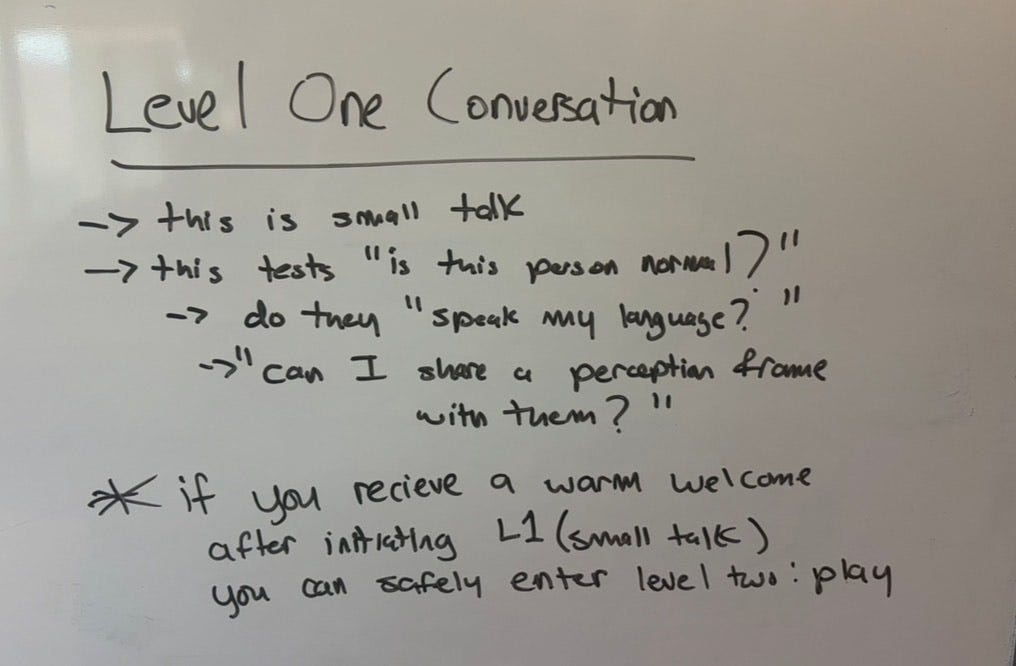
Level One Conversations: Small Talk
Let’s say you’re at a store. That constrains context pretty heavily. People are there to get food. So, let’s say you see a beautiful woman and you want to say something. Why not? Say she’s picking up an item of food you’ve had before, and you’re waiting in line next to her. You could say, “oh, I’ve had those noodles before, they’re good, what are you gunna make with them?” It’s really as easy as that. Now, after this, we have a crucial step that almost every single guy will not do: determine if she wants to continue the conversation.
If she looks at you, smiles, and gives a long answer, you’re in. If she asks you a question, even better. If she gives you a one-word answer and/or looks at you like she’s annoyed, just don’t continue the conversation.
This is level one of a conversation: determine context and ask a basic question. Almost all conversations start like this. We can make it even more basic and not use context, but this makes places such as grocery stores or gyms off-limits. Why? They’re too contextual. People aren’t looking to make friends at the store. Now, if you’re at a bar or a social event, a simple “hey, how are you” could definitely work.
Level Two Conversations: Play
If the first part goes well and the other person’s signals permit, we can move to level two. Those signals are simple: smiling, having enthusiasm, and uttering words and sentences at a similar pace to you. Most grocery store conversations will end at level one, but if you get to level two, you can definitely land a girl’s number in a grocery store. Level two is initiating a play sequence, but what is play? Play has a long etymology that basically boils down to “a voluntary dance along the edges.”
Perception frames have edges. But what is a perception frame? It’s defined by the context of the situation. The context of a grocery store has a tightly defined perception frame. Motivation and focus are high in this context, and most people will dismiss things they perceive as irrelevant when attempting to achieve their goals. In this case, grabbing their apples and chicken breasts. This makes activating a play sequence much harder. Let’s consider the context of a bar for this level.
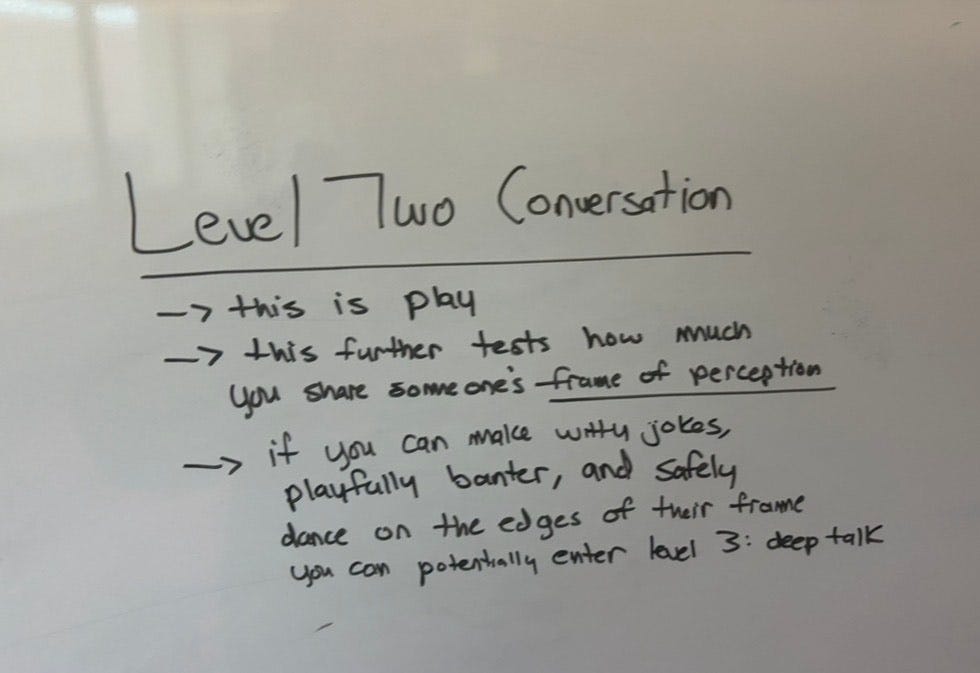
In a bar, play is very easy. People go to bars to play. Seriously. You know what alcohol does, technically? When it enters your brain, it A) lowers your inhibitions, but B) it also makes you not care about your responsibilities. Both of those things make it more likely you will play. Playing is controlled chaos, though sometimes alcohol leads to uncontrolled chaos. But within the bounds of a conversation, play is right on the edge. You’re saying things that could make someone mad, if not delivered with a smirk. You’re observing slightly taboo things. You’re saying things no one expected. You’re engaging in fantasy.
Here’s a simple example: I was out to eat the other night with a friend, and the waiter came up and said Santa and the Grinch would be at the restaurant on Saturday. Perfect setup for a joke. I said, “Are you sure they should be in the same building? They might fist-fight.” Everyone laughed. Then the waiter jumped in, to my surprise. He said, “yeah I know, everyone is kind of spooked, but apparently they’re supposed to meet at the end of the night in the middle of the restaurant. Who knows what will happen then.” Everyone laughed again.
This back and forth is perfect. It is definitionally play. It is unexpected. It is safe fantasy, right on the edge. It was all delivered with a smirk. It had a little taboo. It was contextual. That’s play. That’s level two of a conversation. Now let’s consider a more difficult example.
Suppose you’re in a bar. You’ve already opened a group of girls with something like “what are you celebrating here.” They said, “Oh, nothing, just having a fun girls’ night.” To the average guy, this might seem like a nothingburger. But remember, level one of a conversation is simply about opening someone up. It’s just about determining that they’re willing. They don’t have to say something crazy. They just have to respond with a similar number of words and a similar vibe. In this case, they did. So, what next?
This is where most guys make a major mistake. They think they have to start talking about themselves, but trust me, they don’t care about you. Yet. Girls just want to have fun. If you listened to Cyndi Lauper as a kid, you already know this. If not, let me explain.
The average guy approaches girls and starts interviewing them. Asking her questions about her life. The girls are thinking something like “I feel nothing for this guy” or “he’s asking me what everyone else does. BORING.” He also fails immediately by trying to isolate the girl he wants. Remember, “if you wanna be my lover, you gotta be my friend.” That means friends with all her friends. You need social proof. So, how do you avoid this trap? The answer is to play.
Play and Level three of conversation share something in common that explains what to do next. It’s about finding a shared perception frame. Something to stake the conversation on safely.
The pick-up artists were excellent at finding shared perception frames. They often chose topics like astrology or magic, which, yes, all girls love unironically. But we don’t want to run routines. They may work, but they’re too robotic. They’re too noncontextual. So, what instead?
There are millions of lines you could go with. You could say, “Who dragged everyone out tonight?” because someone is always the leader. Or you could ask about what someone is drinking and ask them if they really like it and then say “yeah you look like you’d drink Vodka-crans, classic sorority girl” with a smirk. Or you observe something like “I love pint night. Always good to refill my cabinet every six months or so” (that is, if it’s pint night). The point is to say something light. Say something funny. And make sure it’s contextual. This will open up two routes: either someone will fire something back and start to play, or, in the case that you’re with just one person, they may respond with something that allows you to enter deep talk.
Level Three Conversations: Deep Talk
The purpose of play and flirtation is to develop comfort and build a shared perception frame. It’s safer to develop it through play and jokes, because there is a degree of plausible deniability. Once you’ve cracked a fun joke or two, you can easily enter deep talk. These are questions about family, how people really feel about things, and about things that you share in common. Another important aspect of this is trust loops, which we will discuss a bit later.
Here’s an example of stage two entering, transitioning to stage three. I once met a guy at a restaurant who worked in the kitchen. We shared the same philosophical interests, being particularly interested in German philosophy and religious belief structures. I’m not even sure how we got onto the topic, but I made a joke about Friedrich Nietzsche and how his philosophy is about doing, but he didn’t seem to do all that much. This created the shared frame. We both read and admire Nietzsche, but could see his deep flaws. This means we are a very specific type of person who would get along. This opened the opportunity for us to exchange numbers to discuss these matters further.
Let’s take another example to really make the point clear. I went on a date a while back with this girl. She was telling me about one of her friends, saying she hates capitalism and just wants to hang out on the beach naked all day. No kidding, not even a parody. I said, isn’t it crazy how transparently obvious her whole hatred of capitalism is an elaborate cope about how lazy she is? My date laughed. It created what I call a “me too” moment. This is something you’ll hear when you’ve established a shared frame of perception with someone. It means you can enter a trust loop.
A trust loop is simply this, entering a shared frame of perception with someone and bouncing between jokes and deep talk. It basically bounces between each. You’ll explore each other’s inner thoughts, saying a lot of “yeah, I agree” and asking questions like “what do you think about this?” or “how do you feel?” You’ll make jokes about the shared frame.
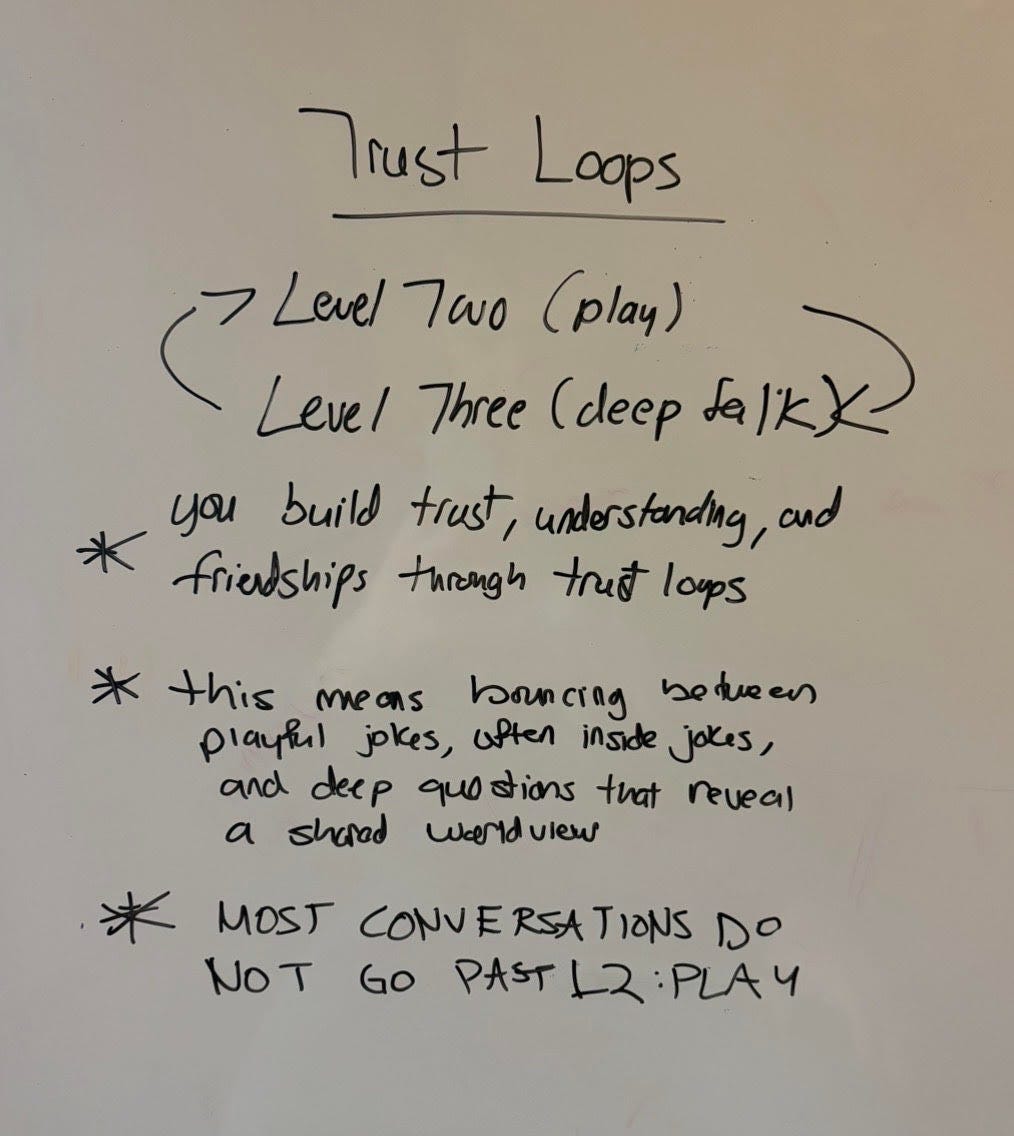
This is how deep friendships and romantic relationships are truly formed. That is the ultimate goal of conversation and of human interaction.
§